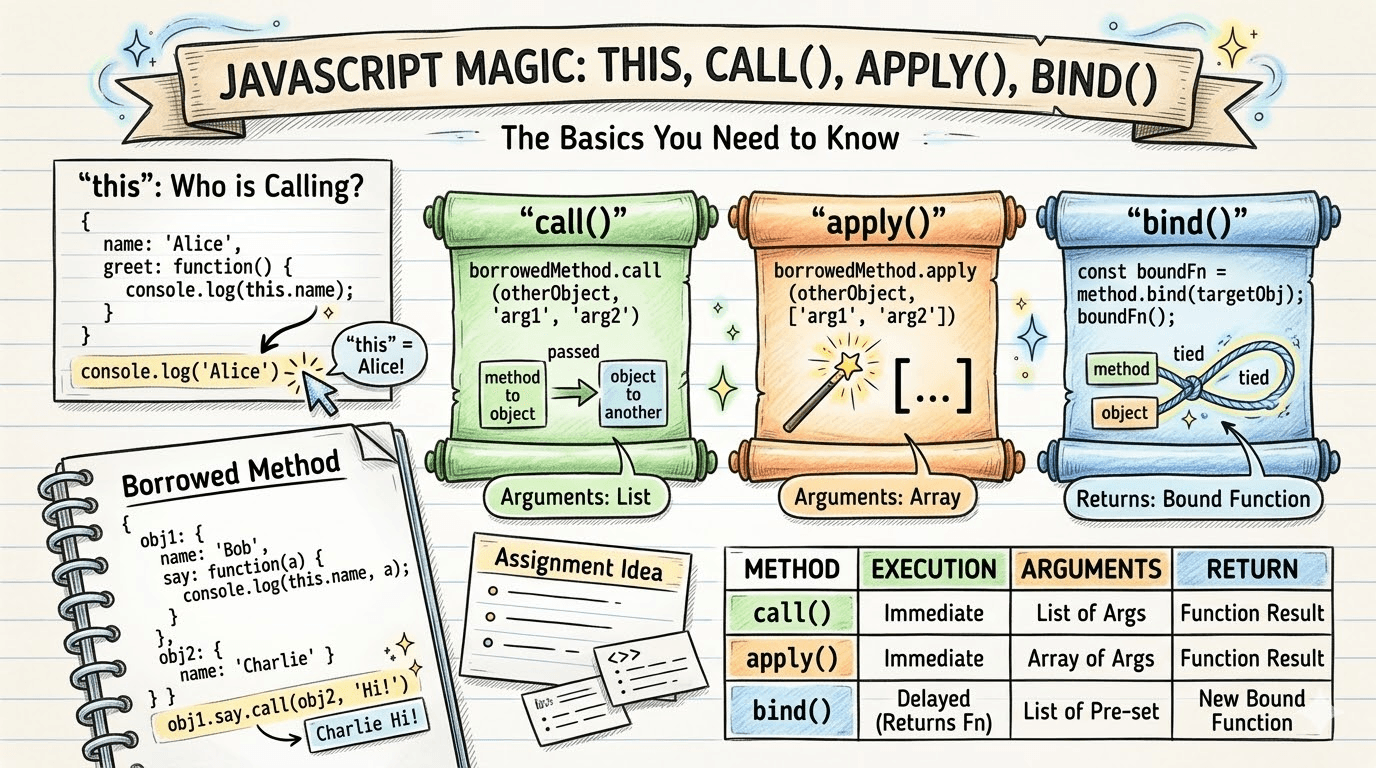
If you have ever been confused by this, you are not alone. The easiest way to understand it is simple: this points to who is calling the function. It is not fixed inside the function body. It changes based on the call site. In this article, we start with this, then move to call, apply, and bind with small examples you can try immediately.
What this Means in JavaScript
this is a keyword that refers to the object that calls a function. The same function can return different this values depending on how you call it.
Think of it like a speaker on a mic. The words are the same, but the person holding the mic changes.
this Inside Normal Functions
In a normal function, the value of this depends on how the function is called.
function showCaller() {
  console.log(this);
}

showCaller(); // In a browser, this is the window object in non strict mode
If you call a normal function without an object, this refers to the global object in non strict mode. In strict mode, it becomes undefined.
"use strict";
function showCallerStrict() {
  console.log(this);
}

showCallerStrict(); // undefined
this Inside Objects
When a function is called as a method of an object, this points to that object.
const user = {
  name: "Piyush",
  greet() {
    console.log(`Hello, I am ${this.name}`);
  },
};

user.greet(); // Hello, I am Piyush
Here, the object user is calling greet, so this is user.
If you copy the method and call it alone, the caller changes. This happens because this is decided at the time of the call, not when the function is written. The same function can behave differently based on the object in front of the dot.
const greetFn = user.greet;

greetFn(); // this is no longer user
In this case, there is no object before the dot, so the function is just a plain function call. In non strict mode, this becomes the global object. In strict mode, it becomes undefined. That is why this.name does not work here.
Another Simple Example
const car = {
  brand: "Honda",
  show() {
    console.log(this.brand);
  },
};

const showFn = car.show;
car.show();   // Honda
showFn();     // global or undefined
This is the most common source of confusion with this.
What call() Does
call() lets you call a function and set what this should be. It takes a list of arguments after the first parameter.
function greet(city) {
  console.log(`${this.name} from ${city}`);
}

const person = { name: "Aman" };

greet.call(person, "Delhi"); // Aman from Delhi
Use call() when you want to borrow a function and run it immediately with a different caller.
What apply() Does
apply() is almost the same as call(), but it takes arguments as an array.
function add(a, b) {
  return a + b;
}

const nums = [4, 6];
console.log(add.apply(null, nums)); // 10
This is helpful when your arguments already exist in an array.
What bind() Does
bind() does not call the function immediately. It returns a new function where this is fixed to a value.
function sayName() {
  console.log(this.name);
}

const person = { name: "Riya" };
const boundSayName = sayName.bind(person);

boundSayName(); // Riya
Use bind() when you want to pass a method around but keep the same caller.
Difference Between call, apply, and bind
callruns the function now and takes arguments one by oneapplyruns the function now and takes arguments as an arraybindreturns a new function that you can run later
| Method | When it runs | How arguments are passed | Result |
|---|---|---|---|
call | Immediately | Comma separated | Function result |
apply | Immediately | Array | Function result |
bind | Later | Comma separated or array | New function |
Assignment Idea
Try this small exercise to make the concepts stick.
- Create an object with a method that uses
this. - Borrow that method using
call(). - Use
apply()with an array of arguments. - Use
bind()and store the new function, then call it.
Example
const profile = {
  name: "Neha",
  intro(role) {
    console.log(`${this.name} is a ${role}`);
  },
};

const other = { name: "Rahul" };

profile.intro.call(other, "Developer");
profile.intro.apply(other, ["Designer"]);

const boundIntro = profile.intro.bind(other);
boundIntro("Engineer");
Quick Recap
thismeans who is calling the function- Normal function calls depend on the call site
- Object methods point
thisto the object callandapplyrun immediately with a chosen callerbindreturns a new function with a fixed caller