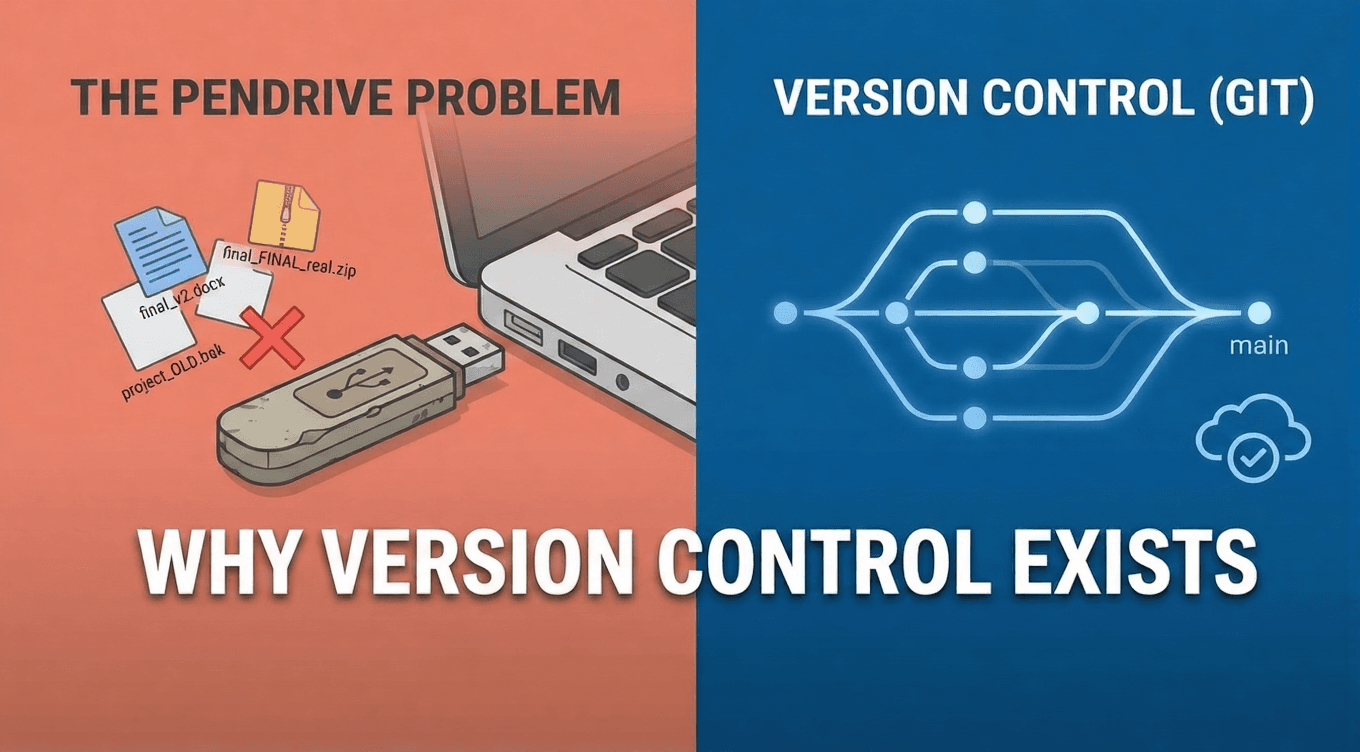
Before Git, before GitHub, before cloud platforms… There was confusion.
Not about how to write code, But about which code was the correct one?
If you’ve ever seen files named like:
-
project_final -
project_final_v2 -
project_final_v3 -
project_final_latest -
project_final_latest_updated
Then you already understand the problem.
Version control exists because developers needed a way to stop losing work, stop overwriting each other’s code, and work together without fear.
The Pendrive Analogy in Software Development
Let’s go back to a time before modern tools.
No Git. No GitHub. No shared repositories.
Just:
-
Pendrives
-
Emails
-
Local folders
-
Trust issues
A very common workflow back then
-
The developer writes some code
-
Copy it to a pendrive
-
Hand it to Developer B
-
Developer B modifies the code
-
Someone forgets which version is the latest
-
Everything breaks
This approach worked only when:
-
There was one developer
-
Or the project was very small
The moment teams grew, problems started showing up.
The Famous “Final” Folder System
Every developer had folders like this:
project/
 ├─ final/
 ├─ final_v2/
 ├─ final_v3/
 ├─ final_latest/
 ├─ final_latest_please_work/
Each folder looked important. None of them was trustworthy.
You could never answer questions like:
-
Which file is the latest?
-
What changed since yesterday?
-
Who modified this line?
This wasn’t laziness. This was the absence of a system.
Problems Faced Before Version Control Systems
1. Code Was Accidentally Overwritten
Two developers edited the same file.
One copied their version last.
The other person’s work?
Gone. No history. No undo button.
2. Changes Were Lost Forever
If something broke, you couldn’t go back and check:
-
What the code looked like yesterday
-
When a bug was introduced
-
Why was a change made
Once overwritten, the old version ceased to exist.
3. No Collaboration History
If a bug appeared, questions followed:
-
Who wrote this code?
-
When was it added?
-
Why was it changed?
Most of the time, the answer was silence.
There was no accountability, not because people were careless, but because the system didn’t support it.
4. Team Collaboration Was Painful
Now imagine:
-
3–5 developers
-
Same project
-
Same files
-
Different copies of code
Everyone was working hard, Yet everything felt fragile.
One wrong copy-paste could break the entire project.
The Real-World Team Problem
As software teams grew, this problem became serious.
Companies needed:
-
Multiple developers working together
-
Safe collaboration
-
A clear history of changes
-
A way to recover from mistakes
Pendrives, emails, and folder naming conventions were never designed for this.
So the question became:
How do we let many people work on the same code without destroying each other’s work?
Why Version Control Became Mandatory
Version control systems were created to solve this exact problem.
Instead of manually sharing files, developers now had:
-
A single source of truth
-
Automatic tracking of changes
-
A complete history of the project
-
Safe ways to combine work from multiple people
Every change is:
-
Recorded
-
Traceable
-
Reversible
Nothing disappears silently.
Pendrive Workflow vs Version Control Workflow
| Pendrive / Email Workflow | Version Control Workflow |
|---|---|
| Manual file sharing | Central repository |
| Files get overwritten | Changes are tracked |
| No history | Full change history |
| Hard collaboration | Team-friendly |
| High risk | Controlled and safe |
Connecting This to Git
Git may feel confusing at first.
Commands. Commits. Branches. Merges.
But Git didn’t make development complicated. It organised problems that already existed.
Every Git feature exists because something used to go wrong:
-
Commits exist because changes were getting lost
-
History exists because teams needed visibility
-
Branches exist because working on the same code was risky
-
Merging exists because collaboration had to be safe
When you understand the pendrive problem, Git starts to feel less intimidating and more logical.
Final Thoughts
Version control is not about tools. It’s about protecting work.
It exists because:
-
Pendrives failed
-
Emails failed
-
“final_v3_latest” failed
Version control became essential because modern software development cannot survive without collaboration.
And collaboration without history, safety, and trust simply doesn’t work.
That’s why version control exists.